Chinese Resources

Showing posts with label Inspired. Show all posts

Friday, February 1, 2013

Translation Practice 2.0

My mini translation challenge continues this week with another post from Seth's Blog. I ran into some issues with this one, and ended up putting my work on Lang-8 to be checked by a native speaker. My biggest issue was whether to add a subject to the sentence or not, or when to add "mistake," since Chinese is a pro-drop language.

I wrote the post in simplified Chinese, since most Lang-8 users are from Mainland China.

Here is my original work, as you can see there are parts that were unclear to me:

两种错误
Two kinds of mistakes

一种错误是过分的防守现状, 投资太多的时间与力量放在保持目前的状况。
There is the mistake of overdoing the defense of the status quo, the error of investing too much time and energy in keep things as they are.
 
另外一种产生于创造(这里需要主题吗?)未来,就是小小的研究变坏了。
And then there is the mistake made while inventing the future, the error of small experiments gone bad.

第二种错误很少害我们受伤,但我们还是依旧的持续做第一种。(需要加错误吗?
We are almost never hurt by the second kind of mistake and yet we persist in making the first kind, again and again.

Here is the Lang-8 user corrected version:

两种错误

一种错误是过分的防守现状,错误地投资太多的时间与力量来维持目前地状况。

另外一种错误在创造未来的时候产生了,即使再小的实验也会因为一个错误而失败。

第二种错误很少让我们受伤,但我们还是依旧续犯第一种错误。


Truth be told, I don't know how well the corrections capture the original meaning, I'll need to discuss with a native speaker. The confusion, for me, comes from the 即使再...也 portion of the third section. I understand that 即使...也 and 再...也 can both be used as a sort of concession of a truth or outcome, for example: 
  • 即使你去了也沒用 (Nothing would have changed even if you had gone)
  • 你到了北京,時間再緊也要去看老師 (When you arrive in Beijing, however tight your schedule is, you must go to visit your teacher.
But, can they both be used together? Furthermore, is that what Seth is saying with the line "the error of small experiments gone bad? I don't think so.

I'll have to give this one some more thought, but I would encourage anyone who has an opinion to comment below. I look forward to uncovering the mystery, and of course, learning a great deal in the process! Stay tuned for the next episode of this mini challenge sometime next week!

The original blog post from Seth can be found here.

Tuesday, January 29, 2013

Sounding like a native (or trying anyway)

Winter break seems to be filled with tons of mini challenges that have been keeping me quite busy. In addition to working on a translation challenge (new post on Friday hopefully), and a news reading challenge (15 articles in the bag so far!), I'm starting a parroting exercise in the hopes of bringing my Chinese pronunciation, speed, and general delivery even closer to a native level.

The idea has actually be festering in my mind every since I saw a video on Youtube talking about 蔣勳's book 《漢字書法之美》. The first viewing blew me away. It wasn't really about the content (although I will be buying his book), but also the way he simply spoke Chinese. His voice, like mine, is deep... and the speed seems perfect for delivering a lecture to eager language learners. After a second and third viewing I decided to figure out a way to work on mimicking him to the best of my ability. He has effectively become my Chinese 發音/口音 muse.


Now, just a month or so later I'm actually on my way. The purpose of this parroting challenge is to see just how close I can come to sounding like this master of Hanzi by the 17th of February, the last day of my winter break. For the sake of making this as public as possible, here is my plan of action.


  1. Transcribe the speech
  2. Split the speech into manageable language chunks (as they are spoken by him)
  3. Benchmark
  4. Mimic every line as close as possible (every single day)
  5. Memorize 
  6. Post results
I worked on step one and two yesterday, and spent around 20 minutes today trying to get a proper benchmark (see my soundcloud upload below). While I'm still way off the mark from the original I was able to get close on speed. Working on the audio file today, made me realize that this is the first time I've actually shared any of my own spoken Chinese on the Internet, or at least since my Chinese was beyond a beginner level, so I'm actually a bit nervous. After giving it a few listens I'm already aware of some tone issues and the crazy pronunciation of the "度" in“適度," but like I said before... it's a benchmark.

I'll be working on cleaning all of those things up over the next few weeks, and I'll probably do a follow-up post before the end.

Well, without future ado, enjoy!


Tuesday, January 8, 2013

Translation practice 1.0: Seth's Blog

Inspired by Dr. Kubler's lecture on advanced learning strategies (see last weeks post) I decided to try my hand at a translation exercise this past weekend. Rather than pick something I've personally written in English, I used Seth's Blog as inspiration. For the past year or so Seth's (short) words of wisdom have been filling my inbox. His blog covers a wide variety of topics and uses language in a powerful and inspirational way--something that is perfect for translation. By using his words I'm forced to step outside of my own Chinese comfort zone.

I'll be following up on this translation practice in the weeks to come (once finals are done and I've had a week or two to decompress), but for now, here are the results of my first translation challenge:

你到底作出啥?

決定。

你並不是個勞工,你所要做的事情就是做決定
問題是,一位種玉米的農場主對自己所有的任務一清二楚。他不會避免種玉米或拖延收割,並且他絕對不會去說服鄰居過來替代他種玉米。

你必須多決定,才能進一步。

I learned a few new words like 農場主、 拖延、收割 during the writing process, and can't wait to write another one of these again in the near future. The fact that Seth's post was A) awesome and B) short made this that much more fun to do! Got any suggestions on how to make my translation better? Please leave them in the comments below.

Original post from Seth's Blog:

What do you make? 
Decisions. 
You don't run a punch press or haul iron ore. Your job is to make decisions.
The thing is, the farmer who grows corn has no illusions about what his job is. He doesn't avoid planting corn or dissemble or procrastinate about harvesting corn. And he certainly doesn't try to get his neighbor to grow his corn for him. 
Make more decisions. That's the only way to get better at it.

Saturday, January 5, 2013

Developing Advanced Language Skills

Part of me wishes I could go back and start my program in Taiwan over again. Not because I got bad grades or didn't learn a lot over the past three semesters, but because there is just so much I didn't know about the program then that I do now. One of those things happens to be the importance of the small lecture series that is always going on in our program. The past four weeks have been very exciting for me in this regard. I've heard lectures for Enya Dai (Associate Professor at Monterey Institute), participated in Taiwan's 2012 International Conference of Teaching Chinese as a Second Language, and heard a compelling lecture from Cornelius C. Kubler (顧百里: Professor of Asian Studies at Williams College).

All of these events have changed my life as a Chinese language student/teacher, giving me new ways to think about teaching, research, and my own linguistic development. I've made some amazing connections with professors, scholars, and students like me from all over the world. I wish that I could go back and start my program over so that I could have attended even more of these events. Since I'm not a Timelord I'll just have to keep calm and carry on (or something like that). 

Today's post, however, isn't really about looking back on missed opportunities, but rather about pressing forward. After yesterday's lecture by Dr. Kubler I realized for the millionth time that there is so much more I can do to bring my Chinese to an even higher level. Dr. Kubler has been studying Chinese for the past 40 odd years, and while he might not have a perfect accent, he speaks Chinese at an incredibly high level... I'd be lying if said I wasn't a little bit jealous. Thankfully, his entire lecture was about developing advanced language skills. While he was speaking from the perspective of an educator, and what we can do to help learners develop high-level proficiency, I was thinking about the question with a personal vested interest.

One thing I felt his lecture was lacking was student accountability for the learning process, but since he was talking to a group of teachers (not students) I'll give him the benefit of the doubt. So, here are a ideas of things we can do to develop advanced language skills, according to Dr. Kubler.
  1. Memorization: It's never too late in your journey of Chinese to memorize 三字經, or 三百首, in fact exposing yourself systematically to this kind of language will help solidify it in your brain for natural recall later. I did this a lot with Tang poetry while living in Beijing, and nothing stops people in their tracks more than a properly quoted line from one of those poems.
  2. Paraphrasing: Open up an old textbook that you've used and see if you can take colloquial sentences and make them formal, or the other way around. Take basic grammar patterns and make them 書面語 etc.
  3. Transcription: Listen to audio files from native speakers and transcribe them into Chinese (or English). This forces us to step away from language we would usually use in Chinese, and helps to solidify grammatical patterns and word phrases that are used by native speakers. 
  4. Get a tutor: I'm not talking about a language partner, or even a person who simply talks to you in Chinese. I'm talking about the kind of person who is anal-retentive about every single mistake you make, someone who will force you to say something again not because it was wrong, but because it is High School level Chinese, not professional. 
  5. Translation: Translate Classical Chinese into Modern Chinese. Translate academic Chinese into colloquial Chinese. Translate colloquial Chinese into academic Chinese. Translate English into Chinese etc. While translation is a hotly debated topic in SLA, there is no doubt that translation of any kind forces you to think about the language in different way, exposing you to a lexicon that is not your own, which can be crucial for further linguistic development. Of course, this should probably be done with the help of a tutor, at least at first. 
  6. Read Scrolling Text: Part of advanced language levels is the ability to read massive amounts of text in a short period of time. This skill is something that must be acquired through practice, it isn't going to come over night. This skill might be developed by taking text and putting it into a scrolling text program, or even watching Chinese TV shows or movies without sound on. 
  7. Parroting: Do you like the way a certain actor talks in Chinese, then why not try to sound just like him? Like memorization, we can work on parroting native speakers to help increase speaking speed, regional accent, and even tones and pronunciation. This again isn't something that will come over night, but it could be very useful at high levels of Chinese. I'll be trying this out in the coming weeks and will be sure to include more details at that time.
  8. Stamina:Increase it! To quote from Dr. Kubler's own lecture notes: the ability to maintain high level of accuracy and fluency over a period of time (often under various kinds of stress) is very important to function at a professional level. How long can you speak Chinese in a single day before you get sloppy? How accurate can you be when giving a lecture or presentation in Chinese? These might not be things that the typical language learner needs, but it is certainly something that I have to work on. I have noticed that after about an hour of giving a presentation in Chinese I tend to get "sloppy" with tones. It is something I'll have to work on. 
The above is not a genearl guideline to language learning, but rather things we need to consider when trying to reach incredibly high levels of fluency in our target language. I for one will be working on these skills for the rest of my life. There is so much more to be said about these individual topics, but today I wanted to just get the big picture idea on the page. In the coming weeks I'll be writing about some of the things I'm trying out to increase my command of Chinese. 

Stay tuned! 

Thursday, September 27, 2012

My serious problem with academic Chinese writing

Well it finally happend. My teacher called me out in class and told me that I need to work on seriously improving my academic Chinese writing ability. She then proceeded to pick apart sentence after sentence of mistakes and translation errors with a look of disgust (okay the last part only happens in my dreams). I've always guessed this was the case, but now I actually know it, and my classmates do too.

Before entering graduate school I had never actually written a research paper in Chinese. I'd never taken a Chinese literature class. Heck, I've only taken three years of formal Chinese language classes in my life; most of which took place in the US, and was not focused on formal writing at all. I have no problem speaking Chinese, cause that is where the focus was, and has always been.

The sad reality is that most of my graduate studies focus on massive input, not output. The average lecture is three hours long, and (we) as students are lucky if the teacher can put a name to a face by the end of the semester. In my first year in the program I wrote roughly 20 papers, some of which were 10 pages or more, but the majority were 2-3 pages of very colloquial writing.

Aside from the grades posted at the end of the semester, the amount of feedback I received by the end of one year was zilch. No corrections, no comments, not a single "hey 高健 you write like a foreigner! Knock it off!" But now I'm expected to change... and fast, because I have a 100 pape research paper due in just 28 months, and I'll be damned if I let my thesis board call out the way I write.

This isn't me playing the blame game, it is simply the harsh reality of where my Mandarin is, and why it got there.

So, how the heck am I going to fix this?

  • I've signed up for a private tutor on iTalki, with the sole purpose of fixing my academic writing. We start class tomorrow, and I have to email them a paper in a little under two hours.
  • I'll be using Lang-8 to focus more on the translation of English academic articles into Chinese (something I'm going to have to get very good at in the next 24 months). Nothing too long, just key phrases or ideas that I'll need to talk about in my own thesis.
  • I'm going to read more academic journals (in Chinese), about the topics I need to know (got about 30 that I've been putting off cause I never seem to have time).
  • I'm going to write more, and with more focus (more on that later).
I don't know if it will be enough, but it's a start. Cause right now the only thing I wanna to hear my teacher say is "wow, your academic writing is really getting better!"


Tuesday, September 25, 2012

For now or Forever?

Before your next 聽寫 ask yourself, do I want to learn these characters for now or forever?

If you just want to get a good grade on the next day's quiz than by all means copying characters over and over again. It doesn't take much time and you'll probably get an A. 

However, if you want to learn them forever this isn't going to work.  Instead: deconstruct characters, make up mnemonics, don't overload on information, and review old material often. It takes A LOT more time, but you'll remember things for much longer.

Researchers know it. Teachers (generally) ignore it. And students get to make the choice. So, what will it be? 

For now or forever?

Wednesday, January 18, 2012

Why Benny's "Fluent Mandarin in 3 Months" challenge is good for the Chinese community.

It is true, I'm a little behind the game. Admittedly, I only heard about Benny the Irish Polyglot yesterday when Confused LaoWai wrote a post (more like an essay really) titled: On Learning Chinese in 3 Months. Basically, for those still in the dark, Benny has moved to Taipei, Taiwan and will be spending three months learning Mandarin Chinese, with the goal of reaching somewhere near a C1 oral proficiency during that time.

This mission has cause quite the stir in the Chinese language learning community. For a moment, I too wanted to join the masses. While I still take umbrage with the notion that conversational fluency is equal to C1 aptitude, I applaud Benny Lewis for his overall mission statement-- speaking from day one. For a better understanding of his own advice, check out this video from the recent TEDxSanAntonio below.


As with the countless other languages he has learned, he has made a goal (and made it public) and will work at that goal regardless of the outcome. No matter what level his Taiwanese Mandarin reaches, it will be far better than it was three months prior.

As for the Chinese language learning community, his challenge has us talking about learning and studying the Chinese language. While most will (still) admit that Chinese is a relatively hard language to learn, Benny's own mission is to find ways to make studying languages easier... for everyone. This is what sites like Chinesehacks and Hacking Chinese (confusing I know!) do as well, provide ways to make learning Chinese easier and hopefully more fun.

Based on Benny's first week blog I noticed a few things that certainly deserve some praise.
  1. He is relying a lot of context. This is a crucial part to understanding any language. Making assumptions about what the other might be saying will help you figure out appropriate ways to respond to the situation and clue you in on some vocabulary that you can pick up for later use. It is also a great way to fill in the gaps on information you don't know. This works great for both listening and reading (something I covered in some depth over on the Skritter blog).   
  2. He is cultural minded. Handing over money to a cashier with two hands is certainly a good way to make a great impression here in Asia, and these kinds of cultural practices can open doors for further conversation, or at least a little more patience on the part of the locals. I've certainly gotten a lot of conversation out of learning how to drink with Chinese hosts, but lets save that for another post.
  3. He is getting out there. Rather that sit at home and watch TV (which can be a great way to learn some Chinese) he has joined a gym. Basically, he is trying to live his life as he sees fit. Not letting a language barrier get in the way of doing what you would like to do is an important part of language learning and self discovery. I had a similar experience in China when I decided to go to the park and learn how to play the Hulusi (albeit poorly). Sometimes we need to go out and learn by doing (again, something I've covered before.)
So what about the goal: fluency in 3 months? Fluency is a very relative term, and it is his own goal, not ours. However, making goals like this (or maybe something a bit more modest perhaps) are what keep us going on the language learning journey.

I for one will be pushing myself a little bit harder when I'm out living in Taiwan. Speaking more, and trying to be a bit more ambitious. While I personally think that setting a goal that one cannot possibly achieve can be as bad as doing nothing at all, setting goals that strive for us to work harder are how we see positive results.

It reminds me of a great story that Dr. Michael Everson  told my fellow classmates and I this summer. When asked the question of how much effort was needed to learn Chinese (or any language for that matter) he turned to some of the college level athletes and asked them how often the practice their respective sport. The general response was three to four hours a day (seven days a week). The message is quite clear, language, like anything else takes effort, and time. It isn't something that is going to come overnight.


Regardless of the outcome, I hope that Benny's journey will help inspire others to stop making excuses as to why they can't do something, and at least try.

Friday, October 28, 2011

Reflecting on my summer in Beijing

A day doesn't go by that I don't think back to the wonderful experience I had this past summer in Beijing at 中央民族大學(Minzu University of China). I spent six weeks attending Hamilton College's ACC K-12 Chinese Language Teachers Institute for Non-Native Speakers of Chinese with 9 other Chinese teachers. Our goal over those six weeks was to not only improve our Mandarin Chinese, but also explore new ways of teaching Chinese language and culture.

During the course of our program we learned to push our Chinese language skills to a new level (with large help from a Chinese Language pledge) and cover an incredible amount of material: from cultural lectures, and curriculum design, to class visits and Chinese teacher conferences. Now, only a few months later, I still marvel at how much we learned and accomplished during those six weeks.
 
A rough outline of events for the first three weeks. We really had quite the busy schedule.


While I cannot emphasize enough just how much better my Chinese became after those six weeks, I think that even more importantly, I gained a new found confidence (and passion) for teaching Chinese to others. The ability to collaborate with other K-12 Chinese teachers from the United States, and teachers trained in China was, in a word, priceless.

One of the most important lessons I learned, came from the first day of class when we started talking about the "Standards for Foreign Language Learning in the 21st Century." These standards, developed by the American Council on the Teaching of Foreign Languages (ACTFL) are commonly referred to as the 5Cs: Communication, Cultures, Connections, Comparisons, and Communities. These five concepts allow for teachers to provide students with a comprehensive learning experience, that will ultimately allow them to interact (successfully) in the target culture.

Inspired by our summer program and ACTFL's 5Cs, I would like to propose my own Standards for Learning a Foreign Language in the 21st Century, otherwise know as the 5Cs of language learning: Commit, Create, Consider, Crave, and Contribute... to language.

1. Commit yourself to the language you are studying. You don't need to be a genius to speak Chinese, but you certainly have to put in time and energy. During our summer in Beijing we did this by signing a six week language pledge. No matter if we were in the classroom or visiting the park, every word we spoke was in Chinese. This level of commitment isn't for everyone, but it certainly is possible to create your own language pledge in small doses. Giving yourself a commitment, whether it be by only Chinese, or making the time to study everyday is a key to success.

My language pledge (and desktop background for the program) was not only a contract with ACC, but also a contract with myself.
2. Create a study system that works for you. This summer we learned the importance of 因材施教 (yīncáishījiào), or the ability to teach according to a student's individual abilities. We faced this rather daunting task by playing games, making videos and overall thinking about the way that different students acquire new information. However, this is something that we as language learners should consider as well. If something isn't working, don't be afraid to try something else. With the availability of free teaching materials online, trial and error until finding something that works should be encouraged.  


A classmate learns how to teach bargaining by practicing her own skills in our classroom market.
3. Consider your environment. The classroom, the Internet, the streets, the people around you, these are all tools and ways that we can learn something new. A huge part of being a successful language learner is having a spark of curiosity. No matter where we are, there are new things to be learned and absorbed all around us. If you're not in a Chinese speaking environment, that should stop you. Let every encounter with a second language (spoken or otherwise) be a chance for new discoveries and insights. Our program took full advantage of our environment. We even had a class in Black Bamboo Park, where we all had the task teaching our classmates one of the many activities we learned that morning. 

My adventure in Black Bamboo Park had me learning to Chinese waltz!
 4. Crave more than you think you can handle. Push the boundaries of what you think you can do with Chinese. Sometimes we have do something that we think is over our head before we can learn what we are capable of. I never thought that I would be able to speak in front of a group of native speakers in Chinese (without being completely self-conscious) until I found myself doing just that for around 200 Chinese teachers who were heading to American and wanted to know what they should expect. At that point my confidence went through the roof. While those opportunities don't come around every day, it is never to early to start a blog in Chinese, sign-up for a speech competition, or switch your computers operating system. Just be sure to keep telling yourself that you can do it!

My classmate and I leading a two hour presentation on media technology in the classroom. Something we never thought possible before the ACC program.
5. Contribute to the language learning community. No matter if you are a teacher or a student don't be afraid to share your opinion. My summer in Beijing taught that my role as a non-native speaker teaching Chinese is incredibly important.  As non-native speakers we can relate to the mistakes students make, and share our own experiences from learning Chinese. As students, contributing to the language learning community is even more important. Let teachers know what works and what doesn't. Sharing input about what you want to learn will not only make lessons more meaningful, but also encourage initiative and independence in the language learning journey. 

Of course, my 5Cs aren't ACTFL certified, but they are way to keep language learning fresh. Now, living in Taiwan as a grad student, I realize just how much I learned during my six weeks in Beijing. My confidence as a second language speaker, and as a future educator has increase tremendously, and if I could go back again I would.  If you are a non-native Chinese speaker and have a career in teaching Chinese as a second language, or are considering one, I would highly recommend looking into the K-12 Chinese Teacher Training programs.

If you have questions, please leave them in the comments below, or send me an email.

Students and Teachers of the 2011 K-12 Summer Program.

Monday, September 26, 2011

Making time for language.

There are very few people in this world (if any) who can wake up one morning and decide they're going to run a marathon the next day, the next week, heck... even the next month. We aren't able to pick up the guitar and shred like Jimi Hendrix after just a few lessons. Things we do in life require practice, patience, and most importantly dedication. Learning a second language, especially for those of us who can hardly even remember what hitting puberty was like anymore, takes time and energy. 

Go out and ask someone who does something really well how they achieved success.  99.99% of the time it's because they put in a lot of time. They got up every day and worked toward their goal until it became a reality. So what does that mean for us, the language learner? It means we need to stop thinking that things are going to come without effort, or over night. Those kind of thoughts lead to disappointment and failure.


Maybe it's time we take a different approach. Learning a language isn't riding a bike. If you don't keep peddling (and peddling often) you are going to forget how to do it (or rather speak it in this case). So today, I propose that we re-think about how we go about learning a language. Let's start making the time, every single day, so that we can obtain our goal. Of course, the more time we spend, the better the results... but first and foremost lets find our rhythm. 

 
With the rise of the Internet, possibilities are endless. Everywhere you turn there is information ripe for the taking. We have music, movies, blogs, news, textbooks, podcasts etc. all just a single mouse click away. However, just like learning to shred like Jimi, or pushing yourself harder and harder to reach that end goal of 26 miles (and 385 meters) in a marathon, we need to be active and engaged. We need a healthy balance of output and input (especially to speak a language) and we need to practice... a lot. 

 
I don't know about you, but my goals are set high, and I'm going to take the first step toward reaching those goals... I'm going to make the time.

Friday, May 6, 2011

Finding inspiration.

As I prepare to take the Test Of Proficiency, Taiwan's national stadardized test for Chinese language proficiency, I am trying to fit a bit more Chinese studying into my day. At times this can seem like such a daughting task. Work, school, family, and everything else seems to get in the way. However it is important to find time (even if it is a little bit of time every day) to keep up with language study. Sometimes we have rely on those around us for inspiration.

My own recent burst of inspiration has come from Kat over at One Year Chinese. If the blog name doesn't give you enough info, perhaps the About section will:

"Let’s see if I can be fluent in Chinese in a year! Define fluent? Speak with a native Chinese speaker for 10 minutes and convince him I’m a native speaker, too! (Or at least cover that whole 10 minutes without speaking English, without consulting any dictionary, and with no awkward silence lasting for more than 30 seconds!)."


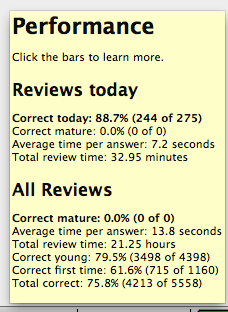
It has been fun to track her progress through her blog and twitterfeed.  After reading about her project I have started to hit the books a bit more as well. While I do get a good dose of Chinese in my film class (中國電影課) and my job with the Chinese Language Tearchers Association (中文教師學會) it still feels good to work on something of my own choosing. My study method of choice has been Anki, a SRS flashcard program. I downloaded the TOP Practice Set with around 8,000 Characters. I have put in 21.25 hours so far . Here are my current results:


A big thanks to Kat and other bloggers who have allowed me to find some inspiration to keep going every day and spend a bit of time hitting the books. I am already seeing improvement. I hope it will get me ready for the TOP on Monday. I also finished using the application Shi Zi: A Primer of Chinese Characters last week but I'm holding off on a review until I can speak to the developer. Look for a proper review within the next few days.
Real Time Web Analytics