Chinese Resources

Friday, October 28, 2011

Reflecting on my summer in Beijing

A day doesn't go by that I don't think back to the wonderful experience I had this past summer in Beijing at 中央民族大學(Minzu University of China). I spent six weeks attending Hamilton College's ACC K-12 Chinese Language Teachers Institute for Non-Native Speakers of Chinese with 9 other Chinese teachers. Our goal over those six weeks was to not only improve our Mandarin Chinese, but also explore new ways of teaching Chinese language and culture.

During the course of our program we learned to push our Chinese language skills to a new level (with large help from a Chinese Language pledge) and cover an incredible amount of material: from cultural lectures, and curriculum design, to class visits and Chinese teacher conferences. Now, only a few months later, I still marvel at how much we learned and accomplished during those six weeks.
 
A rough outline of events for the first three weeks. We really had quite the busy schedule.


While I cannot emphasize enough just how much better my Chinese became after those six weeks, I think that even more importantly, I gained a new found confidence (and passion) for teaching Chinese to others. The ability to collaborate with other K-12 Chinese teachers from the United States, and teachers trained in China was, in a word, priceless.

One of the most important lessons I learned, came from the first day of class when we started talking about the "Standards for Foreign Language Learning in the 21st Century." These standards, developed by the American Council on the Teaching of Foreign Languages (ACTFL) are commonly referred to as the 5Cs: Communication, Cultures, Connections, Comparisons, and Communities. These five concepts allow for teachers to provide students with a comprehensive learning experience, that will ultimately allow them to interact (successfully) in the target culture.

Inspired by our summer program and ACTFL's 5Cs, I would like to propose my own Standards for Learning a Foreign Language in the 21st Century, otherwise know as the 5Cs of language learning: Commit, Create, Consider, Crave, and Contribute... to language.

1. Commit yourself to the language you are studying. You don't need to be a genius to speak Chinese, but you certainly have to put in time and energy. During our summer in Beijing we did this by signing a six week language pledge. No matter if we were in the classroom or visiting the park, every word we spoke was in Chinese. This level of commitment isn't for everyone, but it certainly is possible to create your own language pledge in small doses. Giving yourself a commitment, whether it be by only Chinese, or making the time to study everyday is a key to success.

My language pledge (and desktop background for the program) was not only a contract with ACC, but also a contract with myself.
2. Create a study system that works for you. This summer we learned the importance of 因材施教 (yīncáishījiào), or the ability to teach according to a student's individual abilities. We faced this rather daunting task by playing games, making videos and overall thinking about the way that different students acquire new information. However, this is something that we as language learners should consider as well. If something isn't working, don't be afraid to try something else. With the availability of free teaching materials online, trial and error until finding something that works should be encouraged.  


A classmate learns how to teach bargaining by practicing her own skills in our classroom market.
3. Consider your environment. The classroom, the Internet, the streets, the people around you, these are all tools and ways that we can learn something new. A huge part of being a successful language learner is having a spark of curiosity. No matter where we are, there are new things to be learned and absorbed all around us. If you're not in a Chinese speaking environment, that should stop you. Let every encounter with a second language (spoken or otherwise) be a chance for new discoveries and insights. Our program took full advantage of our environment. We even had a class in Black Bamboo Park, where we all had the task teaching our classmates one of the many activities we learned that morning. 

My adventure in Black Bamboo Park had me learning to Chinese waltz!
 4. Crave more than you think you can handle. Push the boundaries of what you think you can do with Chinese. Sometimes we have do something that we think is over our head before we can learn what we are capable of. I never thought that I would be able to speak in front of a group of native speakers in Chinese (without being completely self-conscious) until I found myself doing just that for around 200 Chinese teachers who were heading to American and wanted to know what they should expect. At that point my confidence went through the roof. While those opportunities don't come around every day, it is never to early to start a blog in Chinese, sign-up for a speech competition, or switch your computers operating system. Just be sure to keep telling yourself that you can do it!

My classmate and I leading a two hour presentation on media technology in the classroom. Something we never thought possible before the ACC program.
5. Contribute to the language learning community. No matter if you are a teacher or a student don't be afraid to share your opinion. My summer in Beijing taught that my role as a non-native speaker teaching Chinese is incredibly important.  As non-native speakers we can relate to the mistakes students make, and share our own experiences from learning Chinese. As students, contributing to the language learning community is even more important. Let teachers know what works and what doesn't. Sharing input about what you want to learn will not only make lessons more meaningful, but also encourage initiative and independence in the language learning journey. 

Of course, my 5Cs aren't ACTFL certified, but they are way to keep language learning fresh. Now, living in Taiwan as a grad student, I realize just how much I learned during my six weeks in Beijing. My confidence as a second language speaker, and as a future educator has increase tremendously, and if I could go back again I would.  If you are a non-native Chinese speaker and have a career in teaching Chinese as a second language, or are considering one, I would highly recommend looking into the K-12 Chinese Teacher Training programs.

If you have questions, please leave them in the comments below, or send me an email.

Students and Teachers of the 2011 K-12 Summer Program.

Monday, September 26, 2011

Making time for language.

There are very few people in this world (if any) who can wake up one morning and decide they're going to run a marathon the next day, the next week, heck... even the next month. We aren't able to pick up the guitar and shred like Jimi Hendrix after just a few lessons. Things we do in life require practice, patience, and most importantly dedication. Learning a second language, especially for those of us who can hardly even remember what hitting puberty was like anymore, takes time and energy. 

Go out and ask someone who does something really well how they achieved success.  99.99% of the time it's because they put in a lot of time. They got up every day and worked toward their goal until it became a reality. So what does that mean for us, the language learner? It means we need to stop thinking that things are going to come without effort, or over night. Those kind of thoughts lead to disappointment and failure.


Maybe it's time we take a different approach. Learning a language isn't riding a bike. If you don't keep peddling (and peddling often) you are going to forget how to do it (or rather speak it in this case). So today, I propose that we re-think about how we go about learning a language. Let's start making the time, every single day, so that we can obtain our goal. Of course, the more time we spend, the better the results... but first and foremost lets find our rhythm. 

 
With the rise of the Internet, possibilities are endless. Everywhere you turn there is information ripe for the taking. We have music, movies, blogs, news, textbooks, podcasts etc. all just a single mouse click away. However, just like learning to shred like Jimi, or pushing yourself harder and harder to reach that end goal of 26 miles (and 385 meters) in a marathon, we need to be active and engaged. We need a healthy balance of output and input (especially to speak a language) and we need to practice... a lot. 

 
I don't know about you, but my goals are set high, and I'm going to take the first step toward reaching those goals... I'm going to make the time.

Saturday, September 10, 2011

A quick way to enter (proper) 拼音 (pīnyīn) on a Mac

If the rest of you are like me, then at least once a day there comes a point where you will need to type something out in pīnyīn. Of course we can take the easy way out, adding numbers to the end of the word, but lets be honest... it just doesn't look nearly as nice as having tone marks above the word, dui4 bu2 dui4? 

Of course, there are plenty of online-resources out there that will help convert 漢字 to 拼音, but they are often flawed in their own right. Let's take an example from Chinese-tools

Here is the sentence that I put into the translator:
你們好,我叫高健,我來自美國的威斯康辛州。
It came out like this:
nǐ hǎo / hào wǒ jiào gāo jiàn wǒ zì měi dì / dí / de wēi sī kāng xīn zhōu

Not only did the software miss a few crucial characters like 們,來,國, but it also took out all of my punctuation. On top of that, you still have to go through and select characters that appear as 多音字. Another problem with relying on Chinese-tools or other online resources is that you have to be connected to the Internet. 

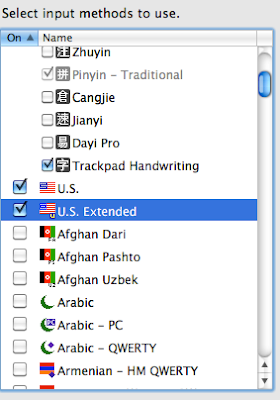
Lucky for Mac users there is an easy solution to the problem. By turing on the U.S. Extended keyboard you can typing in pīnyīn in no time.  Here is how:

Step 1: Open Language & Text in System Preferences. 

Language & Text options found in System Preferences

Step 2: Activate the U.S. Extended input method. 

Find and select U.S. Extended
Step 3: Start typing in pīnyīn!

...okay, so first you need to learn how to actually input the tones, but that just as easy.
  • 一聲 (First tone) is created by pressing A (where ⌥ represents the Option/alt key). When you press it a flat tone mark will appear above whatever letter you are about to type.
  • 二聲 (Second tone) is created by pressing E. Again, pressing this will put a rising tone above the letter you are typing. 
  • 三聲 (Third Tone) is created by pressing V
  • 四聲 (Fourth Tone) is created by pressing  ` 
  •  *** In my original post I completely forgot to address the umlaut. Luckily, John left a comment revealing the trick. As he put it:

    1) Press the LETTER needing the tone marking FIRST, like the "u" in lǜ
    2) then ⌥⇧u to make the umlaut,
    3) then ⌥⇧ plus the a, e, v, or ` to add the appropriate tone marking on top of the umlaut.
In just a few minutes time you will no longer need to rely on the Internet for your pīnyīn dirty work. Another bonus of using the U.S. Extended keyboard is that you now have another opportunity to practice remembering tones every time you want to write in pīnyīn... it really is a win/win. 

*** I would also recommend that you adjust your keyboard shortcuts so that ⌘Space (see images below) will allow you to select between previous input sources, it will save you a ton of time when you are switching between languages, especially if you switch between 简体字 and 繁體字 like I do. 

Good luck and happy pīnyīn-ing! 

Gāo Jiàn
The options for setting up Input source shortcuts.

How your input selection should look when you key ⌘Space.

Sunday, September 4, 2011

An in depth look at "Live the language- Beijing"

The people over the Education First have a great video series entitled "Live the Language". I just found one of the videos about traveling to Beijing. 


For those of you that haven't been, If this video doesn't spark some curiosity in mainland China (specifically Beijing), I really don't know what is going to do it for you. Other than creating an interest in travel, this video can certainly be used as a language learning tool. I enjoy the fact that Chinese characters appear large on the screen, and with pīnyīn too. Even better than that however, is the visual imagery they use along with the characters. There is never really any confusion about the character they are introducing, and without even studying Chinese it is pretty easy to guess and correctly understand the meaning. 


In order to take the language learning experience on step further, I thought we should break down the 35 words featured in the video and provide a bit of background information, along with some sample sentences.


Here are the words, in the order they appear in the video.


北京 (Běijīng): The Capitol of China, with a population of over 20 million. A great place to live and studying Chinese for any expat.

抵达/抵達 (dǐdá): a verb, which means "to reach/ to arrive at". 自上海起行,至今日抵达北京。 Zì Shànghǎi qǐxíng, zhì jīn rì dǐ dá Běijīng. I departed from Shanghai, today I arrived in Beijing.


欢迎/歡迎 (hūan yíng): a verb, which means "welcome/ greet". The most common example of this verb is 欢迎您来到北京 (or another location). Hūanyíng nín lái dào Bēijīng. Welcome to Beijing.

您好 (nín hǎo): a formal greeting used for first encounters or for people that have a higher status than the speaker, also used as a way to show respect. This one doesn't really need an example sentence, since it is a set phrase that can be used by itself. 

寄住家庭 (jì zhù jiā tíng): This is actually a mistake in the video. They have the pīnyīn correctly listed as jì sù jiā tíng, which should actually be 寄宿家庭, which is a homestay family. It is a great way to quickly improve your Chinese (or any language for that matter) and integrate into the target culture. 你们的项目有没有寄宿家庭住宿?Nǐmen de xìangmù yǒu méi yǒu jì sù jiā tíng zhù sù? Does your program offer any homestay housing options?

礼物/禮物 (lǐ wù): a noun meaning gift or present, which has the measure word 件 (jiàn). 我今天要去做生日,你觉得我应该送什么礼物? Wǒ jīntiān yào qù zuò shēng rì, nǐ juéde wǒ yīnggāi sòng shénme lǐ wù? I'm going to celebrate a birthday today, what do you think I should give as a gift?

* Cultural note, if you are going to someones house for a dinner, or staying with a host family, you should come with a small gift. For more info on dinner etiquette or gift ideas, click here.

音乐/ 音樂 (yīn yùe): a noun meaning music. 我喜欢听音乐. wǒ xǐhuān tīng yīnyuè. I like to listen to music. 

地铁/ 地鐵 (dì tǐe): a noun meaning subway system. Beijing is filled with subway lines that will take you all over the city. Sometimes you have to transfer lines, but it is certainly much cheaper than taking a cab, and it is a great way to practice your listening... because if one thing is sure, you will not be alone on the subway. 我想去故宫。我可以座地铁到吗? wǒ xiǎng qù Gùgōng. wǒ kěyǐ zuò dìtiě dào mǎ? I want to go to the Forbidden City. Can I take the subway there?

学校/ 學校 (xúe xiào): a noun meaning school, which has the measure word 所 (sǔo). 学校明天放假. xúe xiào míngtiān fàngjià. There will be no school tomorrow.


书法/ 書法 (shū fǎ): a noun meaning calligraphy, one of the ancient art forms of China. I don't think this one really needs a sample sentence. However, I will say this, if you are thinking about learning calligraphy, then start paying attention to your stroke order early, and I would recommend studying traditional Chinese characters.

老师/ 老師 (lǎo shī): a noun meaning teacher. This character has three measure words depending on the situation or how much respect you are giving. Of course 个 can be used to say 一个老师, but you can also say 名 (míng) or even 位 (wèi), which are much more formal. 

包子 (bāo zi): a stuffed bun. This is a pretty staple breakfast in China. You can buy them individually, or per 笼 (lóng). 一笼包子多少钱? yī lóng bāozi duōshǎo qián? How much for a long of baozi?

厨师/ 廚師 (chú shī): a chef or a cook. For this noun you also want to use 位 as a sign of respect for the position. 

溜冰 (liū bīng): a verb-object pattern, which means to ice-skate or to roller-skate. This is quite popular among kids in the park, you will often seem them practicing in the afternoons while their parents chat with friends close by.

谢谢/ 謝謝 (xièxie): a verb meaning thank you. Much like 你好/您好, this is a set phrase that doesn't need any explanation. Saying 谢谢 is one of the easiest ways to get Chinese people to compliment you on your Chinese!

打盹 (dǎ dǔn): a verb-object pattern meaning doze or take a nap. 西班牙人午休的時候,通常會打盹一下. xībānyárén wǔxiū de shí hòu tōngcháng huì dǎdǔn yīxià. The Spanish often will take a nap during their mid-afternoon break. 

踢毽子 (tī jiànzi): another verb-object pattern meaning to play shuttlecock (or Chinese Hacky sack). It is a common sight to see in the park, and a lot of fun. 如果你去公园,你会看到很多人在踢毽子.  rúguǒ nǐ qù gōngyuán nǐ huì kàn dào hěn duō rén zài tī jiànzi. If you go to the park you will see a lot of people playing Chinese Hacky sack. 

菜单/ 菜單 (cài dān): a menu found in a restaurant. Not much explanation needed for this one. After you got a hold of a menu and ordered food you can say 买单 (mài dān) to ask for the bill.

筷子 (kuài zi): these are chopsticks, something that you should really learn how to use before you arrive in China. Even if Chinese people see you using them they might still ask: 你会用筷子吗? nǐ huì  yòng kuàizi ma? Can you use chopsticks? 

面条/ 麵條 (miàn tiáo): this is the standard way to say noodles. They come in all shapes, sizes, and flavors. Sometimes they drop the 条 off of the name of the dish so start focusing on 面 and remember that your getting noodles. 

卡拉OK (kǎ lā OK): a lone word meaning, you guessed it, Karaoke. This is a very popular pastime activity in China. You generally rent a private room where you and your friends can order snacks, and sing your hearts out. Karaoke bars have a wide variety of music, from Chinese to western, just be ready to make a fool out of yourself, and have a great time!

老人家 (lǎorenjia): an old person, just like the video suggests. As a fun note, this is also a colloquial slang for Chairman Mao Zedong. 

一 &  二 (yī and èr): the numbers one and two. I wasn't even going to list this because it is so basic, but I thought that the video was a little misleading in the way they presented to two children. In Chinese, you can also use the word 两 (liǎng), which is commonly used to describe two things, or two people. If you were describing the video you would not say 二个小孩子,but rather 两个小孩子.

晚饭/ 晚飯 (wǎnfàn): a noun meaning supper or dinner. Dinner uses the measure word 顿 (dùn), for example: 我刚刚吃了一大顿晚饭.  Wǒ gānggāng chī le yī dà dùn wǎn fàn. I just got done eating a huge dinner.

酸奶 (suānnǎi): a noun that means yogurt or sour milk. A must try if you are in China. 

晚上 (wǎnshang): meaning evening. 今天晚上你要去哪里? Jīntiān wǎnshàng nǐ yào qù nǎli? Where do you want to go tonight? 

早晨 (zǎochen): (early) morning or daybreak. This is the perfect time in Beijing. It isn't noisy on the street, the breakfast shops are already open, and people are congregating in the parks to enjoy the morning.

天坛/ 天壇 (Tiāntán): A proper noun meaning the Temple of Heaven (in Beijing). This is a wonderful place to check out if you are living in, or are visiting Beijing.

太极 (Tàijí): the Chinese for Tai chi, which is an abbreviated form of 太极拳 (tài jí quán). 


攀登 (pān dēng): a verb that means to climb, clamber or scale. 我半天一直在攀登,終於到山上了. Wǒ bàntiān yīzhí zài pāndēng zhōng yú dào shān shàng le. I climbed for half a day before I finally reached the top of the mountain.

长城/ 長城 (cháng chěng): The Great Wall of China! A place that everyone needs to see with their own eyes. No explanation necessary for this one. I'll just leave you with a picture.

If you have any questions or comments, please feel free to leave them below.

高健

Tuesday, August 30, 2011

Study More Chinese: A website with a fresh look at daily study drills.

Recently I found a community project that is focused on providing free (and fun) ways to learn Chinese. The name is simple-- Study More Chinese. The project is filled with videos, blogs, photos and an open forum. Unlike the pay as you go sites on the net, this site depends on user content to grow and develop, if you find something that you think is interesting, then post it up and share with others. I came across the site on Twitter when Brandon, the creator of Study More Chinese posted a video titled: "Best Chinese Girlfriend Ever at the QingDao China Beer Festival" 


The video is filled with some great vocabulary and got me curious enough to join the site. And I have to admit, that guy has one heck of a girlfriend! One of the things I really enjoy about Brandon's project is the "Daily Chinese Sentence". As he states on the group page: 


A new twist on the passive  'daily word' / 'daily sentence'.  Join this group to receive new Chinese words each day by email & then respond by using them in a new sentence.

It certainly is a twist. Rather than having your inbox filled with random vocabulary words that you will passively observe, this site asks the users to actually join the conversation. It is certainly a fresh take on all those Chinese word of the day messages that are floating around cyberspace. As a group member you can see how others make those two vocabulary words their own. 

If any of you feeling like trying your hand at the Daily Chinese Sentences, then swing over to Study More Chinese and become a part of the community. Part of learning a language means being active in your study, and find things that interest you. This site is a great way to take that to the next level, by allowing you to share your interests with others too.  
Real Time Web Analytics